
Coca-Cola Enterprise Communication Agentic AI Product
Project Summary :
I designed an enterprise AI agent that improves how employees communicate at Coca-Cola, guiding them to send clearer, more necessary messages, which reached 500+ users in its first month.
Coca-Cola Enterprise Communication Agentic AI Product
Project Summary :
I designed an enterprise AI agent that improves how employees communicate at Coca-Cola, guiding them to send clearer, more necessary messages, which reached 500+ users in its first month.
Designing the Agent
Agent Prototypes
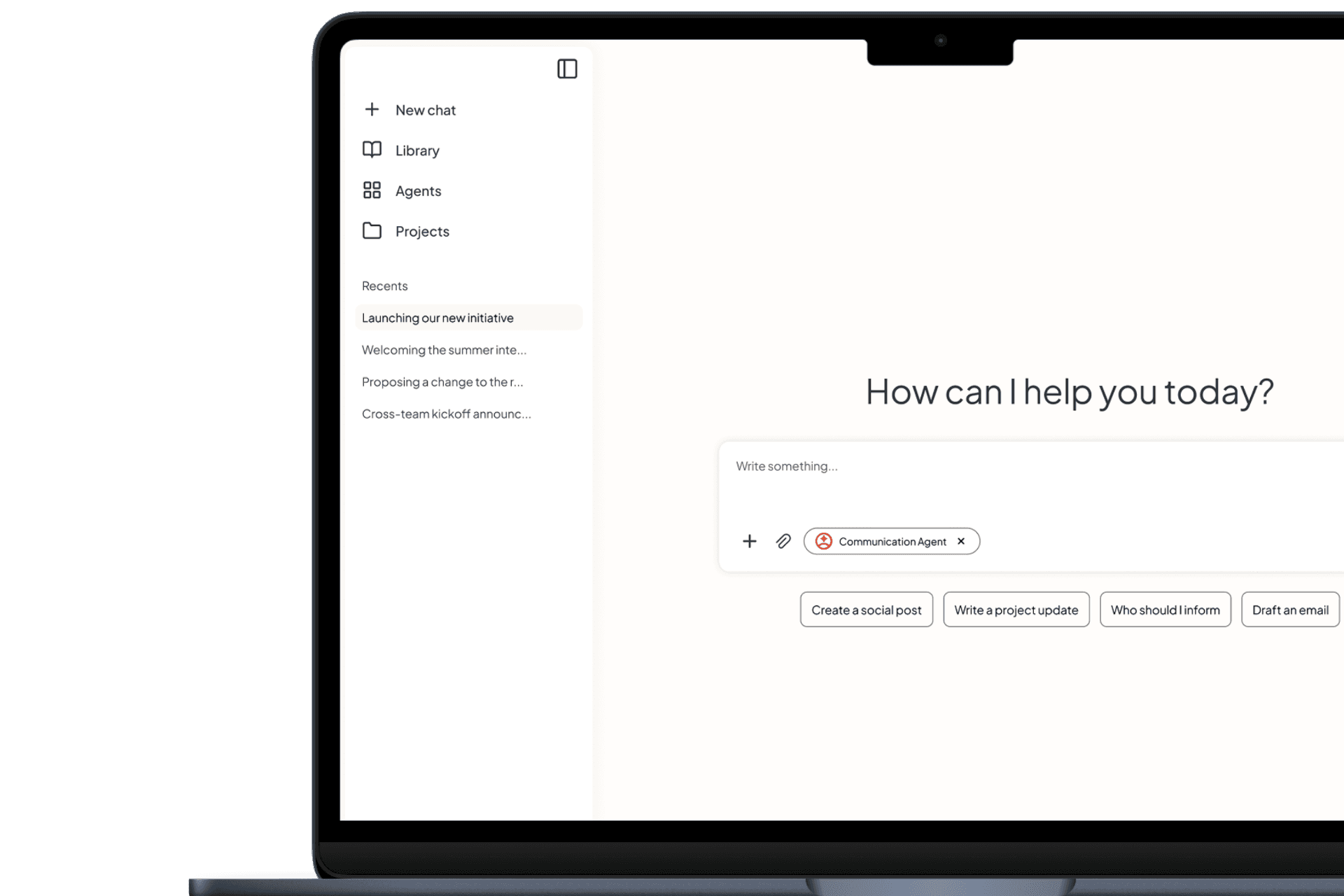
The real prototypes are under NDA, so these are recreated. The agent splits into two versions, one for employees and one for leaders, because the two users need different things from it.
Employee Version
Coaches before it writes. It drafts only once the employee has a clear objective, so the agent fixes the thinking, not just the words. Its knowledge base draws on departmental and enterprise guidelines, platform rules, and past training materials.
Senior Leadership Version
Protects the leader's voice and their secrets. It drafts in the executive's own voice, trained on their past high-impact messages, and restricted access keeps sensitive content and personal style from leaking.
Service Blueprint
I mapped how someone moves through the agent step by step, which told me what to prototype and where the experience could break. It also showed the engineering team which AI capabilities they'd need to build.

Designing the Agent
Agent Prototypes
The real prototypes are under NDA, so these are recreated. The agent splits into two versions, one for employees and one for leaders, because the two users need different things from it.
Employee Version
Coaches before it writes. It drafts only once the employee has a clear objective, so the agent fixes the thinking, not just the words. Its knowledge base draws on departmental and enterprise guidelines, platform rules, and past training materials.
Senior Leadership Version
Protects the leader's voice and their secrets. It drafts in the executive's own voice, trained on their past high-impact messages, and restricted access keeps sensitive content and personal style from leaking.
Service Blueprint
I mapped how someone moves through the agent step by step, which told me what to prototype and where the experience could break. It also showed the engineering team which AI capabilities they'd need to build.
Designing the Agent
Agent Prototypes
The real prototypes are under NDA, so these are recreated. The agent splits into two versions, one for employees and one for leaders, because the two users need different things from it.
Employee Version
Coaches before it writes. It drafts only once the employee has a clear objective, so the agent fixes the thinking, not just the words. Its knowledge base draws on departmental and enterprise guidelines, platform rules, and past training materials.
Senior Leadership Version
Protects the leader's voice and their secrets. It drafts in the executive's own voice, trained on their past high-impact messages, and restricted access keeps sensitive content and personal style from leaking.
Service Blueprint
I mapped how someone moves through the agent step by step, which told me what to prototype and where the experience could break. It also showed the engineering team which AI capabilities they'd need to build.
Designing the Agent
Agent Prototypes
The real prototypes are under NDA, so these are recreated. The agent splits into two versions, one for employees and one for leaders, because the two users need different things from it.
Employee Version
Coaches before it writes. It drafts only once the employee has a clear objective, so the agent fixes the thinking, not just the words. Its knowledge base draws on departmental and enterprise guidelines, platform rules, and past training materials.
Senior Leadership Version
Protects the leader's voice and their secrets. It drafts in the executive's own voice, trained on their past high-impact messages, and restricted access keeps sensitive content and personal style from leaking.
Service Blueprint
I mapped how someone moves through the agent step by step, which told me what to prototype and where the experience could break. It also showed the engineering team which AI capabilities they'd need to build.
AI-Augmented Process
Unravel User Needs & Business Alignment
What AI did:
Drafted initial research plan
Synthesized 30+ data points
What I do:
Built a custom Co-Pilot research agent
Refined research scope
Identified key patterns and insights
Creating the Product Strategy
What AI did:
Explored strategic directions
Drafted strategy artifacts
What I do:
Evaluated tradeoffs
Made the final product strategy
Building the AI Agents
What AI did:
Drafted agent skills and logic
What I do:
Tested, fine-tuned, and ensured security guardrails
AI-Augmented Process
Unravel User Needs & Business Alignment
What AI did:
Drafted initial research plan
Synthesized 30+ data points
What I do:
Built a custom Co-Pilot research agent
Refined research scope
Identified key patterns and insights
Creating the Product Strategy
What AI did:
Explored strategic directions
Drafted strategy artifacts
What I do:
Evaluated tradeoffs
Made the final product strategy
Building the AI Agents
What AI did:
Drafted agent skills and logic
What I do:
Tested, fine-tuned, and ensured security guardrails
AI-Augmented Process
Unravel User Needs & Business Alignment
What AI did:
Drafted initial research plan
Synthesized 30+ data points
What I do:
Built a custom Co-Pilot research agent
Refined research scope
Identified key patterns and insights
Creating the Product Strategy
What AI did:
Explored strategic directions
Drafted strategy artifacts
What I do:
Evaluated tradeoffs
Made the final product strategy
Building the AI Agents
What AI did:
Drafted agent skills and logic
What I do:
Tested, fine-tuned, and ensured security guardrails
AI-Augmented Process
Unravel User Needs & Business Alignment
What AI did:
Drafted initial research plan
Synthesized 30+ data points
What I do:
Built a custom Co-Pilot research agent
Refined research scope
Identified key patterns and insights
Creating the Product Strategy
What AI did:
Explored strategic directions
Drafted strategy artifacts
What I do:
Evaluated tradeoffs
Made the final product strategy
Building the AI Agents
What AI did:
Drafted agent skills and logic
What I do:
Tested, fine-tuned, and ensured security guardrails
The Brief
Massive Scale, Long-Term Transformation
67,000
Employees worldwide
1,000+
Posts a day on internal social platform alone
3 Years
Shifting from an email-first culture to a leaner, message- and social-first one, and the change still isn't finished.
AI as Leverage for Better Results
To push the transition further, leadership turned to AI. The brief was direct: build an agentic AI that generates and refines internal communication content, giving employees better messages with less effort. It was a reasonable bet. Whether it was the right one, nobody had checked.
The Brief
Massive Scale, Long-Term Transformation
67,000
Employees worldwide
1,000+
Posts a day on internal social platform alone
3 Years
Shifting from an email-first culture to a leaner, message- and social-first one, and the change still isn't finished.
AI as Leverage for Better Results
To push the transition further, leadership turned to AI. The brief was direct: build an agentic AI that generates and refines internal communication content, giving employees better messages with less effort. It was a reasonable bet. Whether it was the right one, nobody had checked.
The Brief
Massive Scale, Long-Term Transformation
67,000
Employees worldwide
1,000+
Posts a day on internal social platform alone
3 Years
Shifting from an email-first culture to a leaner, message- and social-first one, and the change still isn't finished.
AI as Leverage for Better Results
To push the transition further, leadership turned to AI. The brief was direct: build an agentic AI that generates and refines internal communication content, giving employees better messages with less effort. It was a reasonable bet. Whether it was the right one, nobody had checked.
The Brief
Massive Scale, Long-Term Transformation
67,000
Employees worldwide
1,000+
Posts a day on internal social platform alone
3 Years
Shifting from an email-first culture to a leaner, message- and social-first one, and the change still isn't finished.
AI as Leverage for Better Results
To push the transition further, leadership turned to AI. The brief was direct: build an agentic AI that generates and refines internal communication content, giving employees better messages with less effort. It was a reasonable bet. Whether it was the right one, nobody had checked.
Reseach - Find The Real Problem
Research Methods
I ran the research in two passes. First, a survey (n=42) across the employee base to size the problem and map how people actually communicate, since a handful of conversations can't speak for 67,000 people. Then interviews (n=8) with senior employees and executives who work in communication professionally, to understand why the breakdowns happen and what good looks like.
Identifying the Real Problem
The cause data pointed somewhere the brief hadn't. People weren't writing badly. They were communicating too much, without a strategy, and losing their audience.

Percentage of employees had run into miscommunication

Leading causes of miscommunication
What the Agent Should Know

Platform/Medium Preferences

Communication Style Preferences

Support Tools Preferences
These preferences define what the agent has to know to be useful. It can't write in a vacuum: it needs the norms of each channel, the tone people actually respond to, and the reference material they already trust, so it can fit a message to the moment instead of producing generic text. The agent's value would come from that knowledge, not from raw writing ability.
From Problem to Direction
The survey showed what was breaking. The interviews told me why, and what a fix would actually have to do. They moved the project from naming problems toward shaping a solution, and three themes stood out, each pointing at something the agent would have to handle.
Contextualizing needs
The agent has to adapt a message to each situation, not apply one template.
Lack of overarching strategy
The agent has to guide strategy and curb over-communication, not just generate text.
Limited internal AI capabilities
The agent has to learn and adapt over time, unlike the rigid tools already in place.
Two User Group, Two Different Needs
The research also split the workforce into two communicators with very different needs, and that split would shape the agent.

Employees
The majority of the workforce, below VP level.
Skill:
Not trained communicators.
Struggle to spot their own weak spots.
Stakes:
High volume, low individual stakes.
Problems surface as noise and overcommunication.
Needs from the agent:
Help shape the message and the strategy.

Senior Leaders
A small group, VP level and above.
Skill:
Capable communicators, but time - poor.
Often hand drafts to staff.
Stakes:
Low volume, high stakes.
Every message stands in for the enterprise.
Needs from the agent:
Hold their voice and guard sensitive content.
Reseach - Find The Real Problem
Research Methods
I ran the research in two passes. First, a survey (n=42) across the employee base to size the problem and map how people actually communicate, since a handful of conversations can't speak for 67,000 people. Then interviews (n=8) with senior employees and executives who work in communication professionally, to understand why the breakdowns happen and what good looks like.
Identifying the Real Problem
The cause data pointed somewhere the brief hadn't. People weren't writing badly. They were communicating too much, without a strategy, and losing their audience.
Percentage of employees had run into miscommunication
Leading causes of miscommunication
What the Agent Should Know
Platform/Medium Preferences
Communication Style Preferences
Support Tools Preferences
These preferences define what the agent has to know to be useful. It can't write in a vacuum: it needs the norms of each channel, the tone people actually respond to, and the reference material they already trust, so it can fit a message to the moment instead of producing generic text. The agent's value would come from that knowledge, not from raw writing ability.
From Problem to Direction
The survey showed what was breaking. The interviews told me why, and what a fix would actually have to do. They moved the project from naming problems toward shaping a solution, and three themes stood out, each pointing at something the agent would have to handle.
Contextualizing needs
The agent has to adapt a message to each situation, not apply one template.
Lack of overarching strategy
The agent has to guide strategy and curb over-communication, not just generate text.
Limited internal AI capabilities
The agent has to learn and adapt over time, unlike the rigid tools already in place.
Two User Group, Two Different Needs
The research also split the workforce into two communicators with very different needs, and that split would shape the agent.
Employees
The majority of the workforce, below VP level.
Skill:
Not trained communicators.
Struggle to spot their own weak spots.
Stakes:
High volume, low individual stakes.
Problems surface as noise and overcommunication.
Needs from the agent:
Help shape the message and the strategy.
Senior Leaders
A small group, VP level and above.
Skill:
Capable communicators, but time - poor.
Often hand drafts to staff.
Stakes:
Low volume, high stakes.
Every message stands in for the enterprise.
Needs from the agent:
Hold their voice and guard sensitive content.
Reseach - Find The Real Problem
Research Methods
I ran the research in two passes. First, a survey (n=42) across the employee base to size the problem and map how people actually communicate, since a handful of conversations can't speak for 67,000 people. Then interviews (n=8) with senior employees and executives who work in communication professionally, to understand why the breakdowns happen and what good looks like.
Identifying the Real Problem
The cause data pointed somewhere the brief hadn't. People weren't writing badly. They were communicating too much, without a strategy, and losing their audience.
Percentage of employees had run into miscommunication
Leading causes of miscommunication
What the Agent Should Know
Platform/Medium Preferences
Communication Style Preferences
Support Tools Preferences
These preferences define what the agent has to know to be useful. It can't write in a vacuum: it needs the norms of each channel, the tone people actually respond to, and the reference material they already trust, so it can fit a message to the moment instead of producing generic text. The agent's value would come from that knowledge, not from raw writing ability.
From Problem to Direction
The survey showed what was breaking. The interviews told me why, and what a fix would actually have to do. They moved the project from naming problems toward shaping a solution, and three themes stood out, each pointing at something the agent would have to handle.
Contextualizing needs
The agent has to adapt a message to each situation, not apply one template.
Lack of overarching strategy
The agent has to guide strategy and curb over-communication, not just generate text.
Limited internal AI capabilities
The agent has to learn and adapt over time, unlike the rigid tools already in place.
Two User Group, Two Different Needs
The research also split the workforce into two communicators with very different needs, and that split would shape the agent.
Employees
The majority of the workforce, below VP level.
Skill:
Not trained communicators.
Struggle to spot their own weak spots.
Stakes:
High volume, low individual stakes.
Problems surface as noise and overcommunication.
Needs from the agent:
Help shape the message and the strategy.
Senior Leaders
A small group, VP level and above.
Skill:
Capable communicators, but time - poor.
Often hand drafts to staff.
Stakes:
Low volume, high stakes.
Every message stands in for the enterprise.
Needs from the agent:
Hold their voice and guard sensitive content.
Reseach - Find The Real Problem
Research Methods
I ran the research in two passes. First, a survey (n=42) across the employee base to size the problem and map how people actually communicate, since a handful of conversations can't speak for 67,000 people. Then interviews (n=8) with senior employees and executives who work in communication professionally, to understand why the breakdowns happen and what good looks like.
Identifying the Real Problem
The cause data pointed somewhere the brief hadn't. People weren't writing badly. They were communicating too much, without a strategy, and losing their audience.
Percentage of employees had run into miscommunication
Leading causes of miscommunication
What the Agent Should Know
Platform/Medium Preferences
Communication Style Preferences
Support Tools Preferences
These preferences define what the agent has to know to be useful. It can't write in a vacuum: it needs the norms of each channel, the tone people actually respond to, and the reference material they already trust, so it can fit a message to the moment instead of producing generic text. The agent's value would come from that knowledge, not from raw writing ability.
From Problem to Direction
The survey showed what was breaking. The interviews told me why, and what a fix would actually have to do. They moved the project from naming problems toward shaping a solution, and three themes stood out, each pointing at something the agent would have to handle.
Contextualizing needs
The agent has to adapt a message to each situation, not apply one template.
Lack of overarching strategy
The agent has to guide strategy and curb over-communication, not just generate text.
Limited internal AI capabilities
The agent has to learn and adapt over time, unlike the rigid tools already in place.
Two User Group, Two Different Needs
The research also split the workforce into two communicators with very different needs, and that split would shape the agent.
Employees
The majority of the workforce, below VP level.
Skill:
Not trained communicators.
Struggle to spot their own weak spots.
Stakes:
High volume, low individual stakes.
Problems surface as noise and overcommunication.
Needs from the agent:
Help shape the message and the strategy.
Senior Leaders
A small group, VP level and above.
Skill:
Capable communicators, but time - poor.
Often hand drafts to staff.
Stakes:
Low volume, high stakes.
Every message stands in for the enterprise.
Needs from the agent:
Hold their voice and guard sensitive content.
Redefining the Project
From Content Generator to Communication Coach
The research left me with a problem the brief couldn't solve. A content generator writes cleaner messages, but the real issues were overcommunication, weak strategy, and low proficiency, none of them a writing problem. So I made the case to the Design Director for a different goal: an agent that helps people communicate better, not just write faster. Widening the scope carried risk, since the project began as a focused content tool, but the research backed the change and the Design Director approved it.
Redefining Project Goals
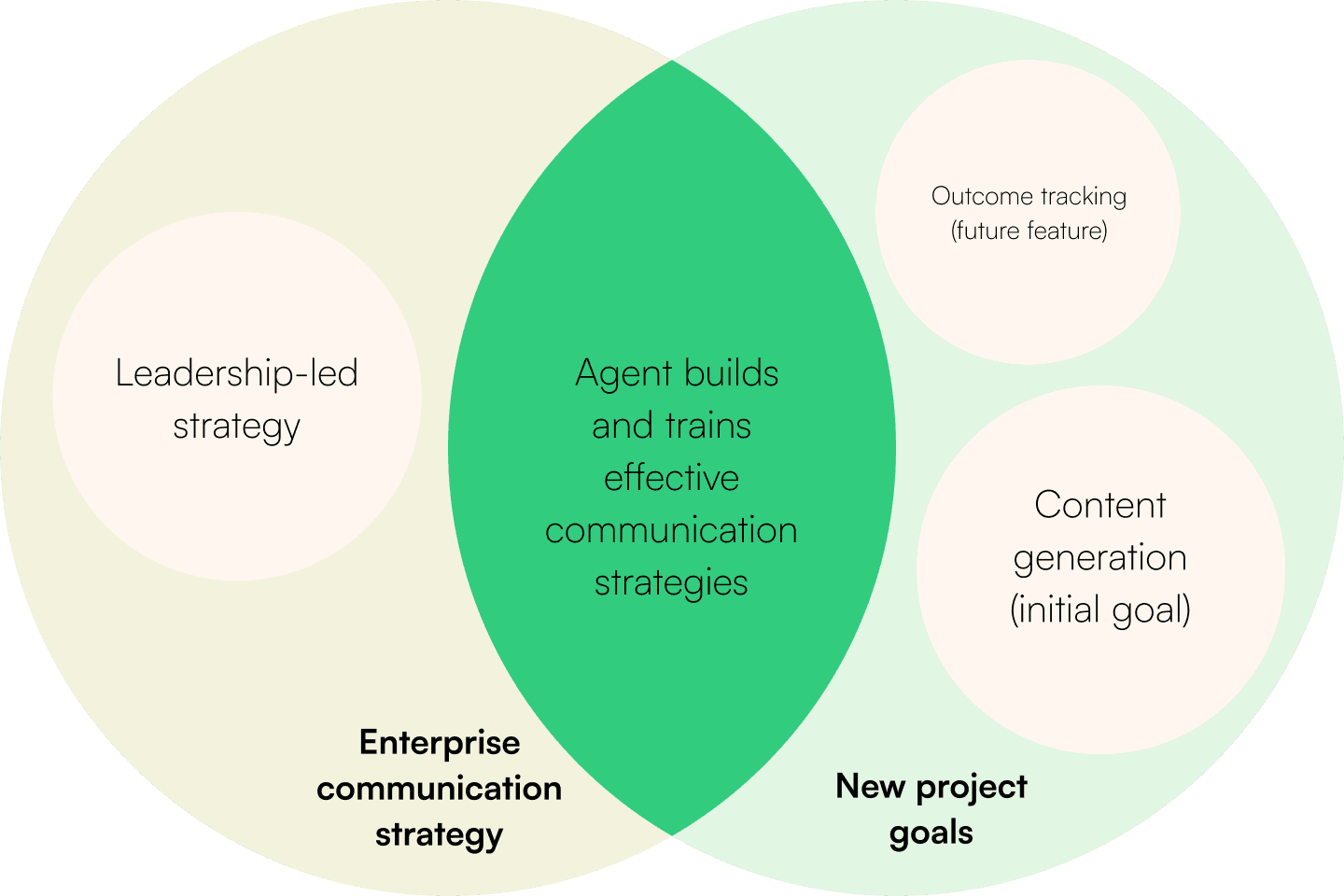
The new goal split the agent's job into three. Content generation, the original brief, became just one of them, sitting under two bigger jobs: helping employees shape a communication strategy, and training better habits over time.
New project goals
Content generation & refinement: draft or adapt a message to fit the need.
Collaborative strategy design: help employees shape a clearer plan and send less.
Communication training: nudge deliberate choices that curb over-communication.
Redefining the Project
From Content Generator to Communication Coach
The research left me with a problem the brief couldn't solve. A content generator writes cleaner messages, but the real issues were overcommunication, weak strategy, and low proficiency, none of them a writing problem. So I made the case to the Design Director for a different goal: an agent that helps people communicate better, not just write faster. Widening the scope carried risk, since the project began as a focused content tool, but the research backed the change and the Design Director approved it.
Redefining Project Goals
The new goal split the agent's job into three. Content generation, the original brief, became just one of them, sitting under two bigger jobs: helping employees shape a communication strategy, and training better habits over time.
New project goals
Content generation & refinement: draft or adapt a message to fit the need.
Collaborative strategy design: help employees shape a clearer plan and send less.
Communication training: nudge deliberate choices that curb over-communication.
Redefining the Project
From Content Generator to Communication Coach
The research left me with a problem the brief couldn't solve. A content generator writes cleaner messages, but the real issues were overcommunication, weak strategy, and low proficiency, none of them a writing problem. So I made the case to the Design Director for a different goal: an agent that helps people communicate better, not just write faster. Widening the scope carried risk, since the project began as a focused content tool, but the research backed the change and the Design Director approved it.
Redefining Project Goals
The new goal split the agent's job into three. Content generation, the original brief, became just one of them, sitting under two bigger jobs: helping employees shape a communication strategy, and training better habits over time.
New project goals
Content generation & refinement: draft or adapt a message to fit the need.
Collaborative strategy design: help employees shape a clearer plan and send less.
Communication training: nudge deliberate choices that curb over-communication.
Redefining the Project
From Content Generator to Communication Coach
The research left me with a problem the brief couldn't solve. A content generator writes cleaner messages, but the real issues were overcommunication, weak strategy, and low proficiency, none of them a writing problem. So I made the case to the Design Director for a different goal: an agent that helps people communicate better, not just write faster. Widening the scope carried risk, since the project began as a focused content tool, but the research backed the change and the Design Director approved it.
Redefining Project Goals
The new goal split the agent's job into three. Content generation, the original brief, became just one of them, sitting under two bigger jobs: helping employees shape a communication strategy, and training better habits over time.
New project goals
Content generation & refinement: draft or adapt a message to fit the need.
Collaborative strategy design: help employees shape a clearer plan and send less.
Communication training: nudge deliberate choices that curb over-communication.
Early Signal and What's Next
Early Signal:
500+
Unique users in North America, first month
53
First month NPS
87.95%
First-month users report helpful in communication
This is the first real evidence that the pivot was right: employees didn't just try the agent; they found it improved their communication, which is the outcome a content generator was never going to reach.
Future Roadmap
A strong first month earned the project room to grow. I built a roadmap to take it from one region to the enterprise, sequenced across three tracks: the communication strategy itself, the technology the agent runs on, and the agent's own capabilities. It hands whoever picks this up a clear path from a working pilot to a company-wide tool.

Tracking KPIs
As the agent scales, I'd keep the measures few rather than track everything the successor team can't act on. Four matter most:
Adoption: whether it's used
NPS: whether it's valued
The drop in duplicate communication: whether it fixes the problem the research found
Time saved: whether it's worth the cost
Early Signal and What's Next
Early Signal:
500+
Unique users in North America, first month
53
First month NPS
87.95%
First-month users report helpful in communication
This is the first real evidence that the pivot was right: employees didn't just try the agent; they found it improved their communication, which is the outcome a content generator was never going to reach.
Future Roadmap
A strong first month earned the project room to grow. I built a roadmap to take it from one region to the enterprise, sequenced across three tracks: the communication strategy itself, the technology the agent runs on, and the agent's own capabilities. It hands whoever picks this up a clear path from a working pilot to a company-wide tool.
Tracking KPIs
As the agent scales, I'd keep the measures few rather than track everything the successor team can't act on. Four matter most:
Adoption: whether it's used
NPS: whether it's valued
The drop in duplicate communication: whether it fixes the problem the research found
Time saved: whether it's worth the cost
Early Signal and What's Next
Early Signal:
500+
Unique users in North America, first month
53
First month NPS
87.95%
First-month users report helpful in communication
This is the first real evidence that the pivot was right: employees didn't just try the agent; they found it improved their communication, which is the outcome a content generator was never going to reach.
Future Roadmap
A strong first month earned the project room to grow. I built a roadmap to take it from one region to the enterprise, sequenced across three tracks: the communication strategy itself, the technology the agent runs on, and the agent's own capabilities. It hands whoever picks this up a clear path from a working pilot to a company-wide tool.
Tracking KPIs
As the agent scales, I'd keep the measures few rather than track everything the successor team can't act on. Four matter most:
Adoption: whether it's used
NPS: whether it's valued
The drop in duplicate communication: whether it fixes the problem the research found
Time saved: whether it's worth the cost
Early Signal and What's Next
Early Signal:
500+
Unique users in North America, first month
53
First month NPS
87.95%
First-month users report helpful in communication
This is the first real evidence that the pivot was right: employees didn't just try the agent; they found it improved their communication, which is the outcome a content generator was never going to reach.
Future Roadmap
A strong first month earned the project room to grow. I built a roadmap to take it from one region to the enterprise, sequenced across three tracks: the communication strategy itself, the technology the agent runs on, and the agent's own capabilities. It hands whoever picks this up a clear path from a working pilot to a company-wide tool.
Tracking KPIs
As the agent scales, I'd keep the measures few rather than track everything the successor team can't act on. Four matter most:
Adoption: whether it's used
NPS: whether it's valued
The drop in duplicate communication: whether it fixes the problem the research found
Time saved: whether it's worth the cost